After resting comfortably in my "
anti-library" for many weeks, I recently plucked
The Black Swan by Nassim Nicholas Taleb from my dusty nightstand. Since I was embarking on cross-continental flights (albeit
with kids), I was looking forward to punctuating the drink-and-peanut monotony of Southwest Airlines (an airline woefully unequipped for flights longer than 90 minutes) with Taleb's insights.
Since my days as a civilian employee of the U.S. Navy, where I evolved from an aspiring systems engineer to a "Science Advisor" to a manager leading the "
Red Team" at
U.S. Joint Forces Command J9, I have been fascinated with the prospect of "adversarial surprise". Like most analytical efforts under the loose employ of the Pentagon (which has roughly one government civilian employee [tail] for every two active duty soldiers/sailors/airmen/Marines [tooth]), this was a cottage industry.
Taleb's insights echo many of our observations in the
Joint Experimentation program, particularly regarding the hubris of intellectualism. His skepticism of inductive logic, his emphasis on the importance of
context in perceiving information, and his lionization of Doktor Prof. Sir Karl Raimund Popper (whom I had the pleasure of driving from leland stanfurd junior u. to Cal some 20 years ago in my Nissan Sentra) as well as Henri Poincaré are worthy of note.
However, his self-referential anecdotes are reminiscent of a Tolstoy novel, and his clear disdain for planning (
née prediction) creates a scotoma that pulls him into the same abyss of solipsism that consumed David Hume.
The depth of his criticisms can be summarized quite succinctly as:
Don't use quantitative methods for qualitative questions.
Nature is benign, so we can ascribe a comfortable level of determinism to our observations. New data, often obtained through technological innovation, requires modification of obsolete theories (e.g., the Ptolemaic model of the universe to the Copernican; Newton's Laws of Motion to Einstein's Special Relativity; etc.). Key to our understanding (though Taleb would probably insist we understand
nothing) is the selection of appropriate parameters -- and to not get too enamored with your own theories, especially if it involves any vestige of "free will".
Fallible? You betcha! Yes, we are inclined to fool ourselves. Yes, we try to cram too many variables into our formulae in some vain hope that we'll "get it right". And yes, our institutions -- particularly financial ones -- tend to reward the wrong kinds of behavior (q.v. Prof. Clay Christensen's
The Innovator's Dilemma, in which Clay digs into corporate failures
vice successes, finding that
Wall Street rewards bad behavior). But Taleb's diatribe against the folly of "epistemic arrogance" has created another confirmation bias that only casually addresses the issue of scale when considering complex topics.
I understand that I am straying far from the "anchor" of many blogfriends (
John Robb,
Art Hutchinson,
General of the Hordes Subadei,
ARHerring,
zenpundit,
Chet Richards) who have offered glowing praise for
The Black Swan. Perhaps it's my naïveté (or perhaps that I'm a product of the California public school system), but I honestly don't see our civilization marching toward "Extremistan". Quite the opposite: While our
awareness of remote events has increased, and our networks have grown exponentially, I believe that the diffuse topology of our networks actually
dampens the impact of an extreme event.
Consider the "Butterfly Effect". Do you
really think a butterfly flapping its wings in Jakarta is going to eventually cause a hurricane in New York City? Or do you think the minor perturbation is absorbed locally without cascading into some kind of
resonance? Yes, there are examples that illustrate
the dire consequences of unplanned resonance. Taleb (who waffles at the end of his book as half hyperskeptic, half intransigently certain) abandons the Gaussian bell curve, yet -- with only a single mention of
Albert-László Barabási -- firmly embraces Power Law scale invariance as normative.Despite Taleb's too-casual treatment of scale, I think he would agree with
George E.P. Box's statement (c. 1987) that "...[A]ll models are wrong, but some are useful." Abandoning our dogmatic devotion to certainty is essential in any creative, innovative enterprise -- and can reveal hidden opportunities, and hidden abilities.
This requires that we reexamine how we define "success". In my adopted hometown of Oak Ridge, Tennessee, the best
Calutron operators (the electromagnets that separated Uranium isotopes for the LITTLE BOY bomb at Y-12 during the Manhattan Project) were
not the scientists from Berkeley who designed them, but seamstresses with no scientific training. And how many Americans would consider Tommy Franks or Norman Schwarzkopf as the most successful U.S. commanders in the Mid-East? What about Tony Zinni (who didn't win a major theater war, but may have demonstrated even greater skill by
avoiding one)?
While many of us point to 9/11 as a "Black Swan", I can say unequivocally that it had a far less dramatic effect on my life than
Continental Flight 196 on March 6th, 1993. Could I have predicted when or how I would meet the woman that would be the mother of my children? Of course not.... But was I open to the possibility, and adaptive enough (when jabbed in the ribs by Helen from Purchasing to move up one row on that flight) to take advantage of this blessing?
That may be the best value of Taleb's
Black Swan: to jar us out of our collective comfort zones, to remind us how ignorant we truly are, and to encourage us to
"Be Prepared!" Good advice, regardless of whether you live in Mediocristan or Extremistan.
____
Update: Überblogger
Zenpundit has graciously
linked this review -- and will have his own review posted this weekend. (Thx Zen!)
Labels: 5GW, books, boyd, chet, complexity, john_robb, reviews, science, soob, zenpundit
 It is a day of deliveries! What better way to see in the Autumnal Equinox, which is occurring the moment I am writing this.
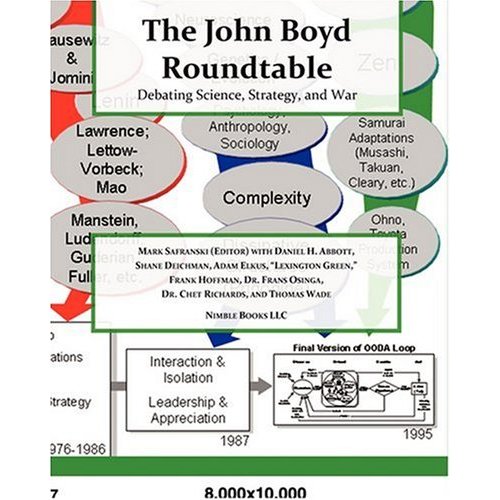 In addition to a baby girl on the way, today is also the formal release of the first book I have been a part of -- The John Boyd Roundtable, ably edited by Mark "Zenpundit" Safranski and published by Nimble Books.