Wizards of Oz

"Life is fraughtless ... when you're thoughtless."

28.6.08

Archduke Ferdinand

In the summer of 1914, tensions across the continent of Europe were nearing a breaking point. The fuse that ignited "The Great War" (World War I) was the assassination of the Archduke Ferdinand and his wife, Duchess Sophie -- heirs to the Austro-Hungarian throne in Vienna -- in Sarajevo by a Bosnian Serb student named Gavrilo Princip.

The Archduke had avoided an earlier attempt on his life that morning by blocking a hand-thrown bomb with his hand (it detonated under his car, wounding 20 along the crowded streets of Sarajevo). After tersely scolding the Mayor of Sarajevo about "getting bombs thrown at [him]", he continued with his planned speech -- after which the Duchess suggested they travel to the hospital to visit the wounded citizens.

A wrong turn put the open-air car right in front of another one of the six plotters. Gavrilo Princip pushed his way to the car and shot the Archduke and Duchess with his 9x17mm semi-automatic pistol.

The subsequent reactions by the "great powers" ignited long-dormant animosities. Compounded by the arms race (particularly in naval affairs, with the British royal family competing with their close relative in Germany, the Kaiser Wilhelm II) and a fragile balance of power, the subsequent conflict would result in 20 million deaths and sow the seeds for Hitler's rise to power.

Labels:

18.6.08

Waterloo

Today (June 18th) is the 193rd anniversary of the Battle of Waterloo - the final defeat of Emperor Napoleon and the eclipse of France's dominance on the Continent by nascent Prussia.

Though the Emperor had been deposed the previous year (after the disastrous march on Moscow in 1812 decimated the Grande Armée) and exiled to l'Isle d'Elbe in the Tyrrhenian Sea, he escaped from captivity and returned to Paris in March 1815. With the remnants of his army rallying around him, Napoleon marched on the British and Prussian forces in Belgium before additional allies could rally and organize a defense.

John Keegan, in The Face of Battle, describes the conditions with impeccable and compelling details - down to the weather the night before, the conditions of the crops on the road near Soignies, and the mood of the troops. While Napoleon commanded total loyalty from his forces, the forces on the field near Braine-l'Alleud were not the same seasoned veterans with whom he conquered the Continent in previous years.

Today, the site of the battle is marked by a tall (40') pyramid, atop which stands a lion in repose. On my very first visit to Europe, 1992 into Brussels, my first "tourist activity" was to take the train south from Brussels to Braine-l'Alleud and a cab to the Butte de Lyon. Since it was early (redeye from CONUS), the omelet fromage I had at a bistro near the train station in Braine-l'Alleud remains one of the most delicious meals I have ever had in my life.

After the battle, the Duke of Wellington is reported to have said, "There is nothing as melancholy as a battle lost -- except, perhaps, a battle won." The second defeat of Napoleon saw the deposed Emperor exiled not to the comfortable confines of l'Isle d'Elbe, near his family's roots in Corsica, but rather to the remote island of St. Helena in the south Atlantic. He died six years later, and is today interred in L'Hôtel des Invalides in Paris (in seven concentric sarcophagi).

Labels: ,

14.6.08

Happy Army Birthday!


Happy 233rd Birthday, U.S. Army! J-HOOah!

Labels: ,

6.6.08

Belleau Wood Teufelhunden

Today, June 6th 2008, marks the 90th anniversary of the U.S. Marine Corps' historic attack on the German Army near Château-Thierry on the Paris-Metz Road just east of Paris. It was in these forests, known as Belleau Wood but renamed after the battle by the French as Bois de la Brigade de Marine (Woods of the Marine Brigade), that Marines came to be known as Teufelhunden: Devil Dogs.

My grandfather (seen here with grandma, also a Marine!) served years later in the 6th Marine Regiment, one of two regiments that comprised the 4th Marine Brigade at Belleau Wood. All Marines in the 5th and 6th Regiments may wear the fourragère, a braided-rope award worn on the left shoulder that has been used to honor distinguished units since Napoleon.

Semper Fidelis!

Labels: ,

27.5.08

Tsushima Day

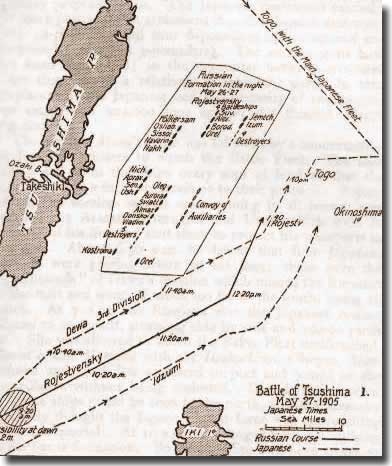
One of the most significant naval battles of the modern era took place this day, May 27th, in 1905, in the Straits of Tsushima between Japan and the southern tip of the Korean Peninsula.

Russia's expansion in northeast Asia in previous years collided with Japanese Realpolitik. Tsar Nicholas II refused to negotiate with Japan, seeing them as an inferior nation lacking the stature to be treated as a peer to Russia. So when Japanese forces seized Port Arthur (modern ShenYung) in the summer of 1904, the Tsar dispatched his Baltic Fleet of 45 ships to "teach" the Japanese a lesson.

Admiral Rozhestvensky and his fleet sailed for more than seven months, around Europe and Asia, approaching the Japanese mainland in late May 1905. At dawn on the 27th, Admiral Togo Heihachiro (aboard his flagship MIKASA) departed the port at Chinhae in Korea -- intercepting the Russian fleet just north of Okinoshima at 14:24 local time.

By sunset (19:30 local time, about five hours later), more than 4,000 Russian sailors were dead and another 7,300 were Prisoners of War. Admiral Rozhestvensky's flagship OSLYBAYA was sunk, along with dozens of other Russian ships. Japanese losses were minimal: three (3) small boats and just 116 killed in action.

Two lessons can be drawn from this encounter. First, the fact that the Russian fleet even made it to Japan is significant -- it was the largest, most complex endeavor by a fleet of that size, compounded by the increased logistics demand of modern ships.

Second, the logistics success was trumped by the monumental failure of Russia's strategic intelligence. Rozhestvensky's total surrender the following morning near Takeshima (Liancourt Rocks) underscored the tactical and technological success of the nimble, cohesive Japanese forces that swarmed around the hapless and confused Russian fleet.

The moral of this story is: never rest comfortably on your laurels -- especially when you're convinced that you have technical and numerical superiority. Tsushima represented a seismic shift in the balance of power in the world, and was the first time that a nation perceived by the "Concert of Europe" as a subject of colonization stood up and resoundingly defeated one of the great powers of the world.

Labels: , ,

26.5.08

In Memoriam

Though it has culturally become the "beginning of summer", Memorial Day's roots are far more somber. President Lincoln's Gettysburg Address (November 1863) is considered by some to be the first observance. Less than two years later, as the American Civil War was drawing to a close, two acts of charity many miles apart sowed the seeds for our present-day observance: In Waterloo, New York, a druggist named Henry Welles promoted the idea of decorating the graves of Civil War soldiers with wreaths; and in many communities across the nation Women's Auxiliaries of the North and South shifted their attention from care to families and soldiers to preserving and decorating the graves of the fallen -- regardless of their "side".

In 1868, General John A. Logan, first commander of the Grand Army of the Republic, issued General Order #11 establishing May 30 as an official memorial day to pay respect to all those who had died, in war or peace. My 'blogfriends at Small Wars Journal have reprinted General Order #11 in its entirety here.

Other 'blogfriends who have commemorated this day include:

Armchair Generalist (noting the impending 9/11 Pentagon Memorial)

Blog them Out of the Stone Age (linking a CBS News piece on Arlington)

Opposed System Design (A brief, poignant post)

Chicago Boys (Lexington Green links to Branagh's brilliant Henry V soliloquy)

ZenPundit (quoting Oliver Wendell Holmes, Jr.)

Danger Room (Noah Schachtman cites LCol McCrae's In Flanders Fields, a Remembrance Day staple in Canada)

Selil (Prof. Sam Liles on the meaning of "service" and "hero")

And most moving of all, our dear friend Melissa (aka BeeDiva) tells us about the father she never knew.

As you enjoy this day, please pause for a moment to pay homage to those who gave their last full measure of devotion so that we can live in liberty.

Update: Two more 'blogfriends have marked the day:

Hidden Unities (Anchors aweigh!)

interact (Sean critiques post-9/11 safeguards and the sorry state of military procurement)

Update 2: Two more 'blogfriends (O.K., three - but two share a site):

Abu Muqawama (AM himself laments the general public's lack of awareness of our military's service)

Abu Muqawama (Kip offers a poignant essay on what Memorial Day means to him)

tdaxp (Dan graciously links back to this post)

Labels: , ,

5.5.08

¡Feliz Cinco de Mayo!

Cinco de Mayo is the celebration of México's victory over Napoleon III at the Battle of Puebla in 1862. Though it is virtually ignored in México (other than in the state of Puebla, just east of Ciudad de México), it has been celebrated for more than 140 years in the U.S. state of California.

While Cinco de Mayo is not México's "Independence Day" (that date is September 16th), in America it has become the cultural equivalent of St. Patrick's Day: a celebration of heritage and culture of our southern neighbor.

So tonight, raise your cerveza or your margarita and honor México!

Labels: , ,

30.4.08

Happy Navy Birthday!

On this date, April 30th, in 1798, President John Adams signed into law the bill that established the Department of the Navy. While the U.S. Navy celebrates its birthday on October 13th (honoring the 1775 founding of the Continental Navy), the modern U.S. Navy -- with its leadership vested in the civilian Secretary of the Navy -- was created on this date. Benjamin Stoddert of Maryland became the first Secretary of the Navy.

Happy Birthday, Navy!


(And a belated Happy Birthday to blogfriend Shlõk, who just yesterday attained an age sufficient to be entrusted with the purchase of alcoholic beverages.)

Labels: , ,

25.4.08

Chernobyl + 22

22 years ago, on a late April evening near the city of Pripyat in northern Ukraine, Reactor #4 at the V.I. Lenin Memorial Chernobyl Nuclear Power Station exploded. This disaster, the only instance to date of a "Level 7" on the International Nuclear Event Scale, resulted in a complete breach of the containment dome accompanied by a severe nuclear meltdown. (By comparison, the Three Mile Island accident in Pennsylvania was a Level 5: "Accident with Off-Site Risk".)

The four reactors at Chernobyl were each GigaWatt-output "reaktor bolshoy moshchnosti kanalniy" (Reactor-High Power-Channel Type, or RBMK). Together, these four reactors provided 10% of Ukraine's electricity.

RBMK reactors rely on light water (i.e., non-deuterium or tritium hydrogen in the water) for cooling, and graphite rods for moderation (akin to the world's first-ever nuclear reactor, the Graphite Reactor in Oak Ridge, Tennessee). Given the size of RBMK reactors and the methods for moderating fast neutrons, they can use natural uranium (vice enriched) for fuel. This also makes the design prone to instability, where boiling coolant can create a very large void coefficient: coolant that is supposed to act as a neutron absorber is boiled away, which increases the reactivity of the core, creating more energy in a positive feedback loop. The added energy can quickly lead to a "Loss of Coolant Accident", which in a large system like the RBMK leads to a catastrophic failure. (BTW: The word "scram" -- which Webster's defines as "a rapid emergency shutdown of a nuclear reactor" -- is actually an acronym coined by legendary physicist Enrico Fermi.)

In late April 1986, while Chernobyl's Reactor #4 was shut down for maintenance, technicians decided to test the ability of the reactor's turbine to power the safety systems should external electrical power be lost. The key question was whether or not the turbines, as they wound down from the reactor, could power the reactor's water pumps while the backup diesel generators came online. Though earlier tests had failed, the technicians wanted to check if recent modifications were sufficient to achieve positive results.

Before the reactor power had been decreased for the test to be conducted, a regional power station went off-line. The grid controller from the Ukrainian capital of Kiev asked that further power reductions from the reactor be postponed to allow sufficient electricity to meet evening demands.

But the night shift was not informed of the postponement. So, when the Kiev grid controller allowed the reactor shut-down to continue, the technicians at Chernobyl instead followed the original test protocol and powered down too quickly. This led to a build-up of Xenon-135 -- a highly-effective neutron absorber that can "poison" a reactor.

Technicians who began to increase the reactor power for the test saw far less power than expected. Unaware of the Xe-135 build-up (and commensurate "burn-off" as neutron flux increased), they removed the graphite rods to increase the reactivity. The increased power and decreased moderation from the graphite rods created steam bubbles in the coolant -- increasing the void coefficient described above. And though the technicians began to "scram" the reactor at 01:23:40 local time, the spike in energy caused the control rods to fracture and jam.

At 01:23:47 local time, as the last of the Xe-135 was burned off, the reactor jumped to 30 GigaWatts thermal: more than twenty times normal operating output. The fuel rods began to melt and the build-up of steam pressure created an explosion that blew off the reactor lid, resulting in a surge of oxygen that caused the graphite to ignite. The loss of containment and the graphite fire exacerbated the spread of radioactive debris throughout the region.

Today, Pripyat and the surrounding area (within a 30km radius of the reactor) is abandoned. Chernobyl has been shut down. However, there are still several RBMK reactors in operation in the Former Soviet Union (in St. Petersburg, Kursk and Smolensk).

Having spent this week at a 5-day "Team Leader Training Course" for the TapRooT Root Cause Analysis methodology, I have a new appreciation for the consequences of "human performance difficulties", particularly with highly complex systems. (Maybe Vinay Gupta and John Robb have a point re: "Resilient Communities" and "simple solar"!)

Labels: ,

24.4.08

Return of the U.S. 4th Fleet

The Pentagon announced earlier today that, effective July 1st 2008, the U.S. Navy will reestablish the U.S. Fourth Fleet. FOURTHFLT will oversee operations in the Caribbean, Central America and South America, and will operate out of the U.S. Naval Forces Southern Command (NAVSOUTH) headquarters in Mayport, FL.

The inaugural COMFOURTHFLT will be RADM Joseph D. Kernan, present commander of Naval Special Warfare Command and the first Navy SEAL (and, by nature of Special Operations, and expert on irregular warfare and COIN) to ever command a numbered fleet.

From today's Miami Herald:

Fourth Fleet to sail again in Latin America
BY CAROL ROSENBERG

It's official: The Pentagon formally announced Thursday that it is reestablishing an administrative entity called the Fourth Fleet -- to oversee Navy vessels that sail the Caribbean, Central and South America. Rear Adm. Joseph D. Kernan, who now runs the Naval Special Warfare Command, will be its new commander.

He becomes the first Navy SEAL, or officer who served in the Navy's elite commando unit, to serve as a numbered fleet commander.

No new headquarters are being created because it will operate out of the U.S. Navy's Southern Command satellite in Mayport.

"Reestablishing the Fourth Fleet recognizes the immense importance of maritime security in the southern part of the Western Hemisphere and signals our support and interest in the civil and military maritime services in Central and South America," Adm. Gary Roughead, the Pentagon's most senior naval officer, said in a statement released Thursday.

The organization becomes effective on July 1.

...

Technically, the Fourth Fleet would answer to the U.S. Southern Command in Miami but supervise the various Navy ships and aircraft that might be assigned to sail south of the U.S. border -- on missions ranging from humanitarian relief to stopping drug trafficking to training with other navies in the Americas.

"This change increases our emphasis in the region on employing naval forces to build confidence and trust among nations through collective maritime security efforts that focus on common threats and mutual interests," Roughead said.

The new fleet restores an institution that was established in 1943 in the South Atlantic as U.S. Navy warships searched for Nazi U-boats. It was disbanded after World War II.

Labels: , ,

30.3.08

San Francisco Travelog

We're spending the weekend in the San Francisco Bay Area. Posterity of Oz (who too-quickly adapted to Pacific Daylight Time, which will make returning to school on Tuesday morning quite problematic) enjoyed visiting the Aquarium of the Bay at Pier 39. The photo above is in one of the "tubes" beneath a school of anchovies, and at right they are petting a skate.

We also paid a visit to the USS HORNET (CV-12) Museum at Alameda Point (the former Naval Air Station), but were deterred by their preparations for a conference of more than 3,000 machinists in the hangar deck. On our way off post, we saw the French maxi-catamaran GITANA 13 -- the sailboat that is shattering records around the globe. The crew of 11 had just set a new record for the Route de l'Or (New York to San Francisco via Cape Horn), breaking the old record by more than 14 days. (Yes, *days*.) They should embark for Japan later this week, where they hope to add the trans-Pacific sailing record to their growing list of accolades.

No visit to the Bay Area is complete without a stop by the alma mater -- and, this time, a trek up Strawberry Canyon to the Lawrence Hall of Science. Their special exhibit this month is "SPEED", with throttle-driven drag racers that risk stalling due to slipping wheels, a side-by-side ski slalom simulator, and a build-it-yourself Lego derby track.

But the main purpose of this weekend was to honor (and thoroughly roast) my mom, who retired last Friday after more than 32 years of service to the Alameda County Health Services Agency. More than 140 colleagues, friends and family came to honor her, while I had the privilege of co-MC'ing -- and laying the blame for the soon-to-be-bankrupt Social Security Trust Fund squarely on her shoulders for leaving the workforce. Truly an enjoyable trip.


Labels: , , ,

19.3.08

Arthur C. Clarke (1917-2008)

Science fiction author, pundit, pioneer and visionary Sir Arthur C. Clarke passed away this morning in his adopted home of Sri Lanka. His short story The Sentinel (1948), which inspired his 1968 novel (and later one of my all-time favorite films) 2001: A Space Odyssey, demonstrated his keen insight into the perils of "artificial intelligence" and technological advancement.

Most notable was Clarke's professed skepticism of humanity and our inclination for self-destruction. A persistent theme in his Odyssey series (both the Space Odyssey as well as his later Time Odyssey trilogy) was the essential role "godlike" aliens played in creating -- and regulating -- sentient life in the Universe. His application of the Second Law of Thermodynamics (that entropy increases over time) and the implicit justification of his aliens' "regulation of life" to postpone the ultimate heat death of the Universe is a compelling syllogism.

Sir Arthur's creativity gave us a glimpse into our own souls, and the cosmic implications of our folly. For that we owe him our gratitude, and our well wishes as he today embarks on his own Rendezvous with Rama.


Update: Other tributes from Sharon @ Danger Room, Kingdaddy, Jason S., Jay M., Soob and Cheryl R.

Labels: , , , ,

9.3.08

Battle of the Ironclads

In early March 1862, the fledgling navy of the Confederate States of America attempted to break the U.S. Navy's blockade in the Hampton Roads of Virginia, at the confluence of the James, York, Elizabeth and Nansemond Rivers. The Commonwealth of Virginia had seceded from the Union less than a year prior (on April 17, 1861), though parts of the Commonwealth remained in Union control (e.g., the western counties -- soon to become the state of West Virginia -- and Fortress Monroe, at the tip of the Virginia Peninsula).

The U.S. Navy retained command of the seas, and imposed a naval blockade on the CSA to restrict their trade -- and their ability to generate revenues to sustain their secession. While northern states were the most populous (shown by Lincoln's victory in the 1860 presidential election -- despite winning zero electors from Southern states or from New Jersey) and most heavily industrialized (with 80% of total U.S. manufacturing capacity and 67% of U.S. rail lines), nearly 50% of America's GDP in the mid-19th century came from cotton. In fact, southern output of cotton was more than 80% of the entire world's production.

When the Commonwealth of Virginia seceded, the U.S. Navy vacated the oldest shipyard in the nation (Gosport Shipyard in Portsmouth, VA, on the Elizabeth River) and scuttled the steam frigate "USS MERRIMACK" in place. The Confederacy raised her and rebuilt her as an ironclad ram, rechristening her as "CSS VIRGINIA".

On the morning of March 8th, 1862, the VIRGINIA steamed into the Hampton Roads with the intention of breaking the Union blockade. Ramming USS CUMBERLAND below the waterline and then forcing the surrender of USS CONGRESS, VIRGINIA returned to port after darkness for repairs. The next morning, she returned to finish off the Union fleet -- but encountered a new arrival to the scene: USS MONITOR, the first true "ironclad" commissioned by the U.S. Navy.

Though the ensuing battle ended in a standoff, the event proved decisive for the Union -- which preserved the blockade's stranglehold on CSA trade.

Our home in Virginia was just a few miles south of the waters where the Battle of the Hampton Roads took place. As proof that to the victor goes the spoils, even south of the Mason-Dixon Line, U.S. Interstate 664 (the western edge of the Hampton Roads' "beltway") crosses the battle site via the Monitor-Merrimac Memorial Bridge-Tunnel (changing VIRGINIA back to its original U.S. Navy name -- albeit without the "k").

Labels: , , ,

23.2.08

A Marine Corps for the next 500 years!

Today is the 63rd anniversary of the legendary flag raising atop Suribachi-san in the black volcanic rock of Iwo Jima. Operation Detachment, the U.S. mission to capture the airfields on this 5,000 acre island approximately 700 miles south of Tokyo, commenced four days earlier (19 February 1945) -- and continued for another month after these five Marines and a Navy corpsman were photographed by Joe Rosenthal. Today, the island is called Iwo To (which was it's name to its residents before World War II, but many Japanese misprounced the character "To" as "Jima").

Secretary of the Navy James Forrestal was inspecting Green Beach on Iwo Jima the morning of 23 February 1945. When the flag was raised, he turned to Marine General H. M. "Howlin' Mad" Smith and said, "The raising of that flag on Suribachi means a Marine Corps for the next five hundred years!"

Joe Rosenthal's photo has been immortalized as the Marine Corps War Memorial in Arlington, Virginia. Note that three of the flag raisers did not survive the subsequent fighting on the island; their stories are poignantly told in the book Flags of our Fathers by James Bradley (son of PM2 John H. Bradley, the Navy Corpsman in the photo).

Semper Fidelis!

Labels:

5.2.08

Osinga Roundtable: Boyd's Evolution

In an October 1939 radio broadcast, Winston Churchill described the Soviet Union as “… a riddle, wrapped in a mystery, inside an enigma.” The same can be said of the late Colonel John Boyd, whose prowess as a fighter pilot and whose lectures on the relationship between energy and maneuverability revolutionized the U.S. Air Force – but who published no books. Rather, his legacy was left in a stack of acetate vu-graphs (thankfully digitized by Chet Richards) and reams of personal papers. For his studious review of the latter, distilling the mind of Boyd into book form, Col/Dr Frans P.B. Osinga deserves our gratitude. He has played Clausewitz to Boyd’s Napoleon.

In Science, Strategy and War: The Strategic Theory of John Boyd, Osinga presents us with a fascinating “deep dive” into the evolution of a brilliant thinker – a thinker who devoted his life to applied learning and teaching. Though it is unfortunate that Boyd did not see fit to publish his theories in book form (unsurprising given his professional environment far from the Ivory Towers of academe), it is evident from his 1,500+ presentations that he rigorously developed and willingly shared his ideas. Boyd’s stamina (both mental and physical) to lecture for more than a dozen hours at a time is testament to his devotion and his determination to succeed.

Osinga nicely complements the work of Boyd biographers (most notably Coram, Hammond and Richards) by dedicating the preponderance of his 300+ pages to how Boyd’s thinking evolved – describing his intellectual influences from the expected (Sun Tzu, Clausewitz) to the unexpected (Popper, Kuhn, Polanyi). Particular attention is given to the influence of classical physicists (Newton) as well as quantum theorists and mathematicians (Heisenberg, Gödel).

Boyd embodied the now-popular notion of the “Medici Effect”, a horizontal thinker who integrated perspectives across multiple, seemingly-divergent disciplines into a cohesive whole. His insights have proven applicable to a wide array of topics, and foretold of the emerging science of complexity theory (though I dislike Osinga’s use of the composite term “chaoplexity”, which undermines the distinction between “chaotic” – i.e., non-linear and seemingly random – and “complex” – i.e., a large number of interrelated properties or parameters). Given the swagger of the fighter pilot who bested the “best” in air-to-air combat in forty seconds or less, there is no doubt that Boyd – were he alive today – would be a prolific ‘blogger, and a Chicago Boyz contributor whose inputs would outweigh all of our Roundtable writings combined.

While many associate Boyd solely with the “OODA Loop”, he has given us far more than just a lexicon – just as Tom Barnett’s work is far more than simply “Core - Gap” and “Leviathan - SysAdmin”. Regardless of one’s willingness to accept his ideas, the sheer effort Boyd invested in his research – and Osinga’s effort in compiling the salient points for us – is an invaluable tool in anyone’s intellectual toolbox.

The motto of the U.S. National Archives and Records Administration is Litera Scripta Manet: “The written word endures.” It is ironic that intellectuals tend to revere the commentator more so than the subject on whom they write: Herodotus over Leonidas, Thucydides over Pericles, Clausewitz over Napoleon. If history is consistent, then in a hundred years the name Osinga may be equally associated with the name of Boyd.


Update: Crossposted at Chicago Boyz.

Labels: , , , , , , , , ,

10.1.08

Crossing the Rubicon

To "Cross the Rubicon" is to pass a point of no return -- to commit yourself to something. In late 50 B.C., the Roman senate ordered Julius Caesar (then Governor of Gaul, a military hero whom the Senate feared) to disband his army and return to Rome. Since his term as Proconsul had ended, and the Senate forbade Caesar from running for a second term in absentia, Caesar knew he would be politically marginalized -- and possibly imprisoned -- if he returned to Rome without the immunity of a Consul.

So, on the 10th of January in 49 B.C. (converted to the Gregorian calendar), Caesar crossed the southern border of Cisalpine Gaul and entered Italy with one legion, Legio XIII Gemina. Since armies were forbidden by Roman law to enter Italy proper (primarily to defend against internal military threats), Caesar's actions marked the beginning of the Roman civil war. He is reported to have said "Alea iacta est" ("The die is cast"), hence our modern association of "Crossing the Rubicon" with passing a point of no return.

What's ironic is you can learn far more about "Fiume Rubicone" (literally "River Rubicon") from Webster's Dictionary and Wikipedia than you can from Rand-McNally. On a March 1994 trip to Europe with my then-girlfriend, I harbored a plot to "pop the question" on the bank of the Rubicon -- after crossing it in our rental car while driving from Venice to Assisi. (If there had been 'blogs in 1994, the dawn of the old NCSA Mosaic web browser, I would have probably done like Dan at tdaxp.... :-)

Only by consulting some large maps at the Navy lab where I worked was I able to find the river. And when we saw it in person, I had a brief pang of regret that I didn't ask Renee to marry me while we were on a gondola floating on the Canale Grande in Venice the night before. But since I had a plan, I stuck to it -- the arrow below shows the spot, and the "scenic grandeur" of what was simply an archaic border between Roman provinces (or a ditch by modern standards):

Labels: , ,

22.12.07

Bloggers for Nuclear Policy

Überblogger ZenPundit has vectored me to a "group blog request" by Cheryl at WhirledView on nuclear weapons policy. This topic was an early passion of mine, while an undergrad physics major at Berkeley in the closing days of the Cold War, so I am happy to participate.

However, I disagree with Cheryl's premise that current U.S. policy is "stuck in the Cold War"; the National Nuclear Security Administration's just-released "Complex Transformation" plan seems like the right plan for continuing to convert our nuclear stockpile to one that is relevant and sustainable for the 21st century.

Three topics I'll cover in this post:
  • Great Power War
  • Stockpile Management
  • Future Challenges
Living in Oak Ridge, Tennessee (a city founded solely because of the Manhattan Project in World War II), there are daily reminders of the role this city played in bringing a terrible war to an end. The old guard posts still stand on the Oak Ridge Turnpike and Scarboro Road, and the three facilities with cryptic alphanumeric names (X-10, K-25, Y-12) still adorn signs and maps.

One thing that becomes clear, touring the various historic sites around Oak Ridge, is the magnitude of effort needed to manufacture nuclear weapons. This is not something where a couple centrifuges can be turned on in a basement and voilà! you have material to build a bomb. The undertaking is complicated, laborious and time-consuming -- and this is a good thing. The skill sets needed to preserve and maintain a credible stockpile are scarce -- and this is not so good of a thing (I'll cover this in "stockpile management" below).

This creates a taxonomy of "Nuclear Powers":
  1. Those that have it
  2. Those that want to have it
  3. Those that don't want it
  4. Those who can never make it
Obviously, those in the first category want to preserve their "exclusivity" -- because after all, the logic of nuclear warfare is that you can never logically use them. This led to policies like the Baruch Plan after World War II (which the Soviets rejected because, in their opinion, it would have preserved the U.S. nuclear monopoly) and today's proper emphasis on nuclear non-proliferation (a great success to date, in my opinion).

Since "great power war" has faded in likelihood, some nations have active nuclear research programs -- ostensibly so they can join the "great power club" and garner increased international standing. This demonstrates the continued effectiveness of deterrence within the nation-state system (where even the most despotic rulers are still governed by some semblance of rational self-interest).

The fourth category ("those who can never make it"), therefore, is the most worthy of attention. A transnational terror organization lacks the resources to develop their own program, so they would have to resort to theft in order to obtain a weapon. (Note that I am deliberately focusing on nuclear weapons, not the other varieties of "Weapons of Mass Destruction" like chemical or biological.) Therefore, in order to minimize the likelihood of an al-Qa'eda-like organization obtaining a nuclear weapon, we should focus our attention on stockpile management.

Since the end of the Cold War, many old weapon systems have been dismantled in order to diminish the U.S. arsenal -- both to abide by international treaty obligations, and to be good stewards of taxpayer dollars. This requires a labor force with the same skill sets necessary to manufacture weapons: not just physicists and engineers, but master machinists, pipe fitters and other skill trades. This is an area where international cooperation should continue to increase -- especially between Russia (which has the largest cache of weapons in the world) and the United States.

Therefore, the three "core values" of a relevant nuclear policy for the 21st century are:
  1. Maintain a credible deterrent (because it's the dominant "control mechanism" in international politics)
  2. Preserve the industrial base (both for demobilization of existing stock as well as for continued research and development)
  3. Continue emphasizing non-proliferation
We can never put the nuclear djinni "back in the bottle". So long as we live in a world ruled by conflicting interests, total disarmament will never be a practical solution.

Labels: , , , , ,

17.12.07

First Flight

Wilbur and Orville Wright, the youngest of a Bishop's four sons, grew up in Dayton, Ohio. Gifted engineers and inventors, they (like most of their contemporaries) were fascinated by the idea of "heavier than air" powered flight. However, while their peers built increasingly powerful motors (figuring that the "flight problem" could be overcome by brute force), the Wright Brothers focused on the challenge of control in three polar dimensions: yaw, pitch and roll.

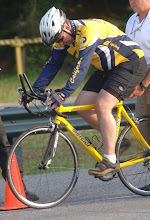
Their engineering acumen came from years of working in their shop with printing presses, motors and bicycles -- the Gary Fishers of the 19th-century. Mechanical skill, coupled with a penchant for data collection (e.g., numerous wind tunnel tests to build better propellers and wings) led to U.S. Patent #821,393: the control surfaces that would later be called ailerons.

Needing a remote place with strong winds, they discovered the Outer Banks of North Carolina. [Ed. note: As one who has experienced the headwinds of Kill Devil Hills, Jockey's Ridge and Kitty Hawk firsthand (on a bicycle during the 2005 "Tour de Cure"), I can testify that Wilbur did good -- OBX is renowned today for it's Kite Boarding!]

On this day, 104 years ago (December 17th, 1903), Orville Wright (below) piloted their plane for a 12-second, 120-foot journey. The brothers made three more flights that day, the final flight (by Wilbur) more than 850 feet in 59 seconds.


Happy flying!

Labels: , ,

16.12.07

The Great White Fleet

America became a global power in the latter days of the 19th century by defeating Spain in the Spanish-American War, taking possession of Puerto Rico, the Phillipines and Guam. Assistant Secretary of the Navy Theodore Roosevelt (credited with preparing the Navy for the war, before resigning his appointment to serve as a Colonel in the U.S. Army) understood the importance of naval power to a nation's economic and military strength.

A decade later, as Roosevelt's presidency was drawing to a close, he dispatched four squadrons of four battleships each (and their escorts) from the Hampton Roads, Virginia on a 43,000-mile, 14-month journey that would circumnavigate the globe. This fleet, "The Great White Fleet", began its journey exactly 100 years ago -- and would demonstrate to the world America's global reach and blue-water navy capability.

Tensions with Japan were rising due to Japan's incredibly lopsided victory over Russia's Baltic Fleet in the Battle of Tsushima two years prior -- and their growing sphere of influence in the western Pacific. This led many (including Harpers magazine) to believe that the outgoing president was launching a war against Japan.

However, Roosevelt's intentions were to build goodwill and cooperation -- akin to the modern U.S. Navy's recently-published "Cooperative Strategy for 21st Century Seapower".


(The above photo, taken from the roof of the Hotel Chamberlin at Fortress Monroe in Hampton, Virginia, shows the fleet passing into the Atlantic at the start of their journey, December 16th, 1907.)

Labels: , ,

14.12.07

National Guard Birthday

The oldest organized military establishment in the Americas, the National Guard of the United States, was founded December 13th, 1636. (Yes, 1636 -- less than a generation after the founding of the Plymouth Colony, and only 29 years after the first permanent British presence in the New World began at Jamestown, Virginia). From Wikipedia:

"On December 13, 1636, the General Court of the Massachusetts Bay Colony had ordered that the Colony's scattered militia companies be organized into North, South and East Regiments--with a goal of increasing the militias’ accountability to the colonial government, efficacy, and responsiveness in conflicts with indigenous Pequot Indians. Under this act, white males between the ages of 16 and 60 were obligated to possess arms and to play a part in the defense of their communities by serving in nightly guard details and participating in weekly drills. After the United States came into existence, state militias would develop out of this tradition."

According to Title X of the U.S. Code, Section 311, the militia of the United States consists of all able-bodied males at least 17 years of age and ... under 45 years of age who are ... citizens of the United States and of female citizens of the United States who are members of the National Guard. This militia is organized into two parts: the National Guard, and the "unregulated militia".

Happy Birthday, National Guard!

Labels: , , ,

7.12.07

A Date Which Lives in Infamy

Flags across the United States are at half-mast today in recognition of "a date which shall live in infamy". At 7:52 a.m. on the morning of Sunday, December 7, 1941, the first wave of Japanese bombers reached the western shore of O'ahu (near today's Lualualei Naval Weapons Station), crested the Waianae Ridge at Kolekole Pass (which connects Lualualei to Schofield Barracks), attacking military airfields as well as the fleet at anchor in Pearl Harbor to the south. More than two thousand sailors, Marines and soldiers were killed -- along with 68 civilians -- compared to just 65 Japanese airmen killed.

The photo above has been a staple of my briefings on defense transformation for years. When I show the photo cropped to show only the lower-right quadrant, nearly everyone correctly observes "Battleship Row" at Pearl Harbor. Showing the full photo (from a scale model in wartime Japan) demonstrates the challenge we in a open society face when battling adversaries who don't share our values -- nor our freedoms.

John Robb has aptly noted our vulnerability to "open source warfare" -- a challenge that is exacerbated by the openness of our society. But the solution is not to trade our freedoms for the "warm blanket of security". Rather, we should remember that it is those freedoms -- the freedom to live, to love, to pursue happiness and prosperity -- that make us strong.

Labels: , , , , , , ,

22.11.07

First Thansgiving Proclamation

By the PRESIDENT of the United States Of America

A PROCLAMATION

WHEREAS it is the duty of all nations to acknowledge the providence of Almighty God, to obey His will, to be grateful for His benefits, and humbly to implore His protection and favour; and Whereas both Houses of Congress have, by their joint committee, requested me "to recommend to the people of the United States a DAY OF PUBLICK THANKSGIVING and PRAYER, to be observed by acknowledging with grateful hearts the many and signal favors of Almighty God, especially by affording them an opportunity peaceably to establish a form of government for their safety and happiness:"

NOW THEREFORE, I do recommend and assign THURSDAY, the TWENTY-SIXTH DAY of NOVEMBER next, to be devoted by the people of these States to the service of that great and glorious Being who is the beneficent author of all the good that was, that is, or that will be; that we may then all unite in rendering unto Him our sincere and humble thanks for His kind care and protection of the people of this country previous to their becoming a nation; for the signal and manifold mercies and the favorable interpositions of His providence in the course and conclusion of the late war; for the great degree of tranquility, union, and plenty which we have since enjoyed;-- for the peaceable and rational manner in which we have been enable to establish Constitutions of government for our safety and happiness, and particularly the national one now lately instituted;-- for the civil and religious liberty with which we are blessed, and the means we have of acquiring and diffusing useful knowledge;-- and, in general, for all the great and various favours which He has been pleased to confer upon us.

And also, that we may then unite in most humbly offering our prayers and fupplications to the great Lord and Ruler of Nations and beseech Him to pardon our national and other transgressions;-- to enable us all, whether in publick or private stations, to perform our several and relative duties properly and punctually; to render our National Government a blessing to all the people by constantly being a Government of wife, just, and constitutional laws, discreetly and faithfully executed and obeyed; to protect and guide all sovereigns and nations (especially such as have shewn kindness unto us); and to bless them with good governments, peace, and concord; to promote the knowledge and practice of true religion and virtue, and the increase of science among them and us; and, generally to grant unto all mankind such a degree of temporal prosperity as he alone knows to be best.

GIVEN under my hand, at the city of New-York, the third day of October, in the year of our Lord, one thousand seven hundred and eighty-nine.

(signed) G. Washington


---

Best wishes for a very happy Thanksgiving to all!

Labels: ,

20.11.07

"The Play" + 25

One of the greatest comebacks in the history of college football took place 25 years ago, on November 20th 1982, at California Memorial Stadium in Berkeley. While Trinity's recent 15-lateral, 62-second play in the final seconds to defeat Millsaps was impressive, as was Boise State's improbable comeback against powerhouse Oklahoma in the 2007 Fiesta Bowl, neither can compare with the magnitude of The Play.

Rivalries like the one between the Golden Bears of the University of California and the "cardinal" (like the, uh, color) of leland stanfurd junior university are rare. Add in the irony of a future NFL Hall of Famer (John Elway) being denied his last shot at a college bowl game (and perhaps the Heisman Trophy), the always-entertaining antics of the stanfurd band, and the drama of stanfurd's "devastated program", and you have a recipe for a legend.

For an in-depth review of The Play -- as well as John Elway's impressive drive in the final minute to temporarily take the lead, and Joe Starkey's emotional play-calling from KGO 810AM's live broadcast, check out this seven-minute clip at YouTube:


Labels: , , , ,

19.11.07

Gettysburg Dedication

The Battle of Gettysburg was fought just prior to the 4th of July, 1863, between General Robert E. Lee's "Confederate States Army" and the Union's "Army of the Potomac" (led by Maj. Gen. George G. Meade, who had assumed command only three days earlier). In addition to being the northernmost battle of the American Civil War, it was also the costliest in terms of lives lost.

Nearly 8,000 soldiers died, and more than 27,000 were wounded. The cemetery atop the ridge on the southeast corner of this small Pennsylvania town, the Soldiers' National Cemetery, was dedicated this day, November 19th, in that same year 1863.

The principal speaker that day was the Hon. Edward Everett, a former Governor of Massachusetts who had also served as President of Harvard University, Secretary of State under President Fillmore, and as a Congressman and U.S. Senator. He was considered the nation's foremost orator of the day, and asked that the dedication be delayed from the originally planned date of September 23rd in order to prepare an "appropriate" speech.

After Ambassador Everett's two-hour speech, President Abraham Lincoln delivered one of the most well-known speeches in our nation's history: the Gettysburg Address. His two-minute long, 10-sentence, 272-word speech reaffirmed the notion of human equality, recast the ongoing war as a "new birth of freedom", and asserted the primacy of the nation-state over the rights of individual states to protect individual freedoms.

Though the Civil War would rage for another 17 months, with tens of thousands more to perish, our nation is the greater for Lincoln's tireless efforts to preserve not only the Union, but the values that make our Union great.

And again, "it is for us the living" to ensure that those words from seven score and four years ago remind us of our duty to the future -- that government of the people, by the people, for the people shall not perish from this earth.

Labels: ,

12.11.07

Do the Dew

My personal favorite soft drink (Mountain Dew) was invented right here, in east Tennessee, some 60 years ago. The trademark was awarded on this day, November 12th, 1948, to the Hartman brothers of Knoxville (who invented the drink as a mixer for whiskey).

Pepsi-Cola bought the franchise in 1964, and today there are nearly a dozen flavors and several brand varieties. Knoxville Trivia Blog has a great timeline on the Dew's evolution (including early marketing techniques to correlate the drink to Appalachia-distilled Moonshine), and even Wikipedia has a page on the drink.

Labels: , ,

11.11.07

Veterans/Remembrance Day

The armistice that ended "The Great War" (World War I) was signed on the 11th hour of the 11th day of the 11th month: November 11th, 1918. Europeans commemorate this day as "Armistice Day", Americans as "Veterans Day", and citizens of the Commonwealth as "Remembrance Day".

Poppies grow in profusion in Flanders (northern Belgium), where many many casualties of the war were buried. The poem "In Flanders Fields" was written by a Canadian physician, Lieutenant Colonel John McCrae, in the trenches on the battle front a day after he witnessed the death of his friend Lieutenant Alexis Helmer. The poem:


In Flanders fields the poppies blow

Between the crosses, row on row
,
That mark our place; and in the sky

The larks, still bravely singing, fly

Scarce heard amid the guns below
.

We are the Dead. Short days ago
We lived, felt dawn, saw sunset glow,
Loved, and were loved, and now we lie
In Flanders fields.

Take up our quarrel with the foe:
To you from failing hands we throw
The torch; be yours to hold it high.
If ye break faith with us who die
We shall not sleep, though poppies grow
In Flanders fields.


As we honor the service of those who ensure our security, let us also remember those who gave their "last full measure of devotion" -- in Flanders Fields, and elsewhere.

Labels: , , ,

10.11.07

Happy USMC Birthday!


The Marine Corps was founded 232 years ago today, on November 10th 1775, in a tavern on the Philadelphia waterfront near today's Penn Landing. A marker denoting the approximate location of the Tun Tavern (now under Interstate-95) is located on the east side of Front Street, between Walnut Street and Chestnut Street.

In 1921, Commandant Lejeune began the tradition of formally recognizing the founding of the Corps:
On November 10, 1775, a Corps of Marines was created by a resolution of the Continental Congress. Since that date, many thousand men have borne the name Marine. In memory of them, it is fitting that we who are Marines should commemorate the Birthday of our Corps by calling to mind the glories of its long and illustrious history.
The record of our Corps is one which will bear comparison with that of the most famous military organizations in the world's history. During 90 of the 146 years of it's existence the Marine Corps has been in action against the nations foes. From the battle of Trenton to the Argonne. Marines have won foremost honors in war, and in the long eras of tranquility at home. Generation after generation of Marines have grown gray in war in both hemispheres and in every corner of the seven seas that our country and its citizens might enjoy peace and security.

In every battle and skirmish since the birth of our Corps Marines have acquitted themselves with the greatest distinction, winning new honors on each occasion until the term Marine has come to signify all that is highest in military efficiency and soldierly virtue.

This high name of distinction and soldierly repute we who are Marines today have received from those who preceded us in the Corps. With it we also received from them the eternal spirit which ha